
Tropical cyclone Alfred updates: Rare Category 2 storm nears Australian coast as millions face ‘worst-case scenario’

Your support helps us to tell the story
From reproductive rights to climate change to Big Tech, The Independent is on the ground when the story is developing. Whether it’s investigating the financials of Elon Musk’s pro-Trump PAC or producing our latest documentary, ‘The A Word’, which shines a light on the American women fighting for reproductive rights, we know how important it is to parse out the facts from the messaging.
At such a critical moment in US history, we need reporters on the ground. Your donation allows us to keep sending journalists to speak to both sides of the story.
The Independent is trusted by Americans across the entire political spectrum. And unlike many other quality news outlets, we choose not to lock Americans out of our reporting and analysis with paywalls. We believe quality journalism should be available to everyone, paid for by those who can afford it.
Your support makes all the difference.
People on the projected path of Cyclone Alfred have been asked to “act now” and leave before the situation gets worse as an “extremely rare” Category 2 storm barrels towards Australia’s southeastern coast.
“There is a chance this cyclone will cross in the middle of the night with a high tide. That is not the time to be making your evacuation plan, now is the time,” Queensland premier David Crisafulli warned.
Brisbane is shutting down trains, buses and ferry services from Wednesday and several matches and events have been cancelled in Queensland and New South Wales (NSW).
Alfred is now about 325km east of Brisbane, according to the Bureau of Meteorology (BoM). It is moving towards the southeast Queensland coast at 16kmph.
There’s a concern that Alfred could slow down to 11kmph, which would be the “worst case scenario”, Higgins Storm Chasing’s Thomas Hinterdorfer told The Courier-Mail.
The storm is expected to make landfall on Thursday or Friday north of Brisbanebringing more than half a metre of rain, flooding and destructive winds.
Alfred is the first cyclone to directly impact Brisbane since Nancy in 1990.
Crisafulli urges residents to follow evacuation orders
Queensland premier David Crisafulli urged residents near coastal areas to follow evacuation orders.
“If it was the case that this [cyclone]which has strengthened, was to cross on high tide in the middle of the night, and you’re in that storm surge, the last place you want to be is in your home. So, now’s the time [to evacuate],” he said.
“If you are in a storm tide zone or you’re in an area where you know there is riverine flooding, you really need to consider and think about your evacuation plan now,” Crisafulli added.
Australian prime minister also pledged to “provide any necessary resources” to support state governments in their rescue efforts.
Maroosha Muzaffar5 March 2025 11:00
Elderly woman injured in dangerous Gold Coast surf as officials warn public to stay away
A 78-year-old woman was hospitalised with head injuries after being swept up by a large wave at Currumbin Beach on Wednesday evening.
The Queensland Ambulance Service confirmed she sustained a deep cut but was in stable condition at Gold Coast University Hospital.
Acting Mayor Donna Gates urged residents to avoid beaches as the storm nears.
Maroosha Muzaffar5 March 2025 10:54
More schools closed
More schools in NSW are closing this week due to the potential impacts of Tropical Cyclone Alfred, including flooding risks.
Over 230 public schools, 29 Catholic schools, five independent schools, and 16 TAFE campuses have shut down, with two TAFE campuses now serving as evacuation centres.
NSW education minister Prue Car emphasised that safety is the top priority.
“While we usually do not advocate for the closure of schools and places of learning, in these circumstances, an abundance of caution can be what keeps our community safe.”
Schools are expected to reopen on Monday, 10 March.
Maroosha Muzaffar5 March 2025 10:54
ADF delivers quarter of a million sandbags
Prime minister Anthony Albanese says that the Australian Defence Force (ADF) is now formally engaged in responding to Tropical Cyclone Alfred, as the system threatens Queensland and northern New South Wales.
An additional 250,000 sandbags will be delivered to the Queensland government, he told the media.
“We put in place a national supply; 125,000 of those have already been delivered,” Mr Albanese says. “That’s on top of the 80,000 that were delivered by the ADF already.”
Stuti Mishra5 March 2025 10:00
Cyclone Alfred latest map, forecast and warnings
Tropical Cyclone Alfred is moving closer to the southeast Queensland and northern NSW coast, with damaging winds, storm surges, and life-threatening flash flooding expected to worsen overnight into Thursday.
Alfred is now just 325km east of Brisbane and 305km from the Gold Coast, according to the latest (5pm local time) update from the Bureau of Meteorology (BoM).
The area covered by the Cyclone Alfred warning zone stretches approximately 450-500 km along the east coast of Australia, from Double Island Point in Queensland to Ballina in New South Wales.
Damaging winds of 120kmph are already hitting Coolangatta and Ballina while gusts up to 155kmph could hit coastal areas as far south as Cape Byron from Thursday afternoon.
Dangerous storm tides could cause flooding in low-lying coastal areas if landfall coincides with high tide early Friday, the bureau said.
Heavy to locally intense rainfall is expected from late Thursday into Friday, increasing the risk of flash flooding.
Alfred is forecast to make landfall early Friday between Maroochydore and Coolangatta as a Category 2 cyclone.
Stuti Mishra5 March 2025 09:19
Airport closures and flight cancellations due to Cyclone Alfred
Airports are shutting down and flights are being cancelled across southeast Queensland and northern New South Wales as Tropical Cyclone Alfred nears the coast.
Gold Coast Airport: The airport will close from 4pm today until further notice. No access will be allowed to the terminal, and people seeking shelter are being directed to the Burleigh Waters Community Centre evacuation centre.
Ballina Byron Gateway Airport: All flights cancelled for Wednesday and Thursday. A total of 22 flights were scheduled to arrive or depart.
Coffs Harbour Airport: Flights suspended from midnight Wednesday until at least midday Thursday.
Lord Howe Island: All Qantas flights cancelled on Wednesday.
Brisbane & Sunshine Coast Airports: Currently operating, but airlines warn further cancellations are possible.
“We have proactively cancelled a number of flights today from southeast Queensland and northern New South Wales,” a Qantas Group spokesperson said.
“The situation remains fluid and flight cancellations and delays will evolve over the coming days.”
Earlier, airlines including Qantas, Virgin, Jetstar announced frexible fee-free date change options.
Qantas & Virgin: Customers who booked before 3 March can change their flight within 14 days or cancel for a travel credit.
Jetstar: Free date change 7 days before or 14 days after the original travel date, or a voucher for the full value of untravelled flights.
Stuti Mishra5 March 2025 08:25
Map: Heavy rainfall forecast from Cyclone Alfred
Cyclone Alfred is expected to bring torrential rain, with some areas receiving up to 600mm over the next few days, according to forecast from Bureau of Meteorology (BoM).
The heaviest rainfall will likely occur south of landfall, affecting Brisbane, the Gold Coast, the Sunshine Coast, and northern New South Wales.
Expected rainfall totals by region:
Sunshine Coast to Gold Coast: 400-600mm, possibly higher in some areas
Brisbane and Moreton Bay region: 300-500mm
Northern NSW (Tweed, Byron, Lismore, Grafton): 250-400mm, with isolated higher totals possible in river catchments
Coastal areas from Fraser Island to Port Macquarie: 200-350mm
The most intense rainfall is forecasted to hit Thursday night into Friday, with rainfall rates exceeding 200mm in just three hours in some areas.
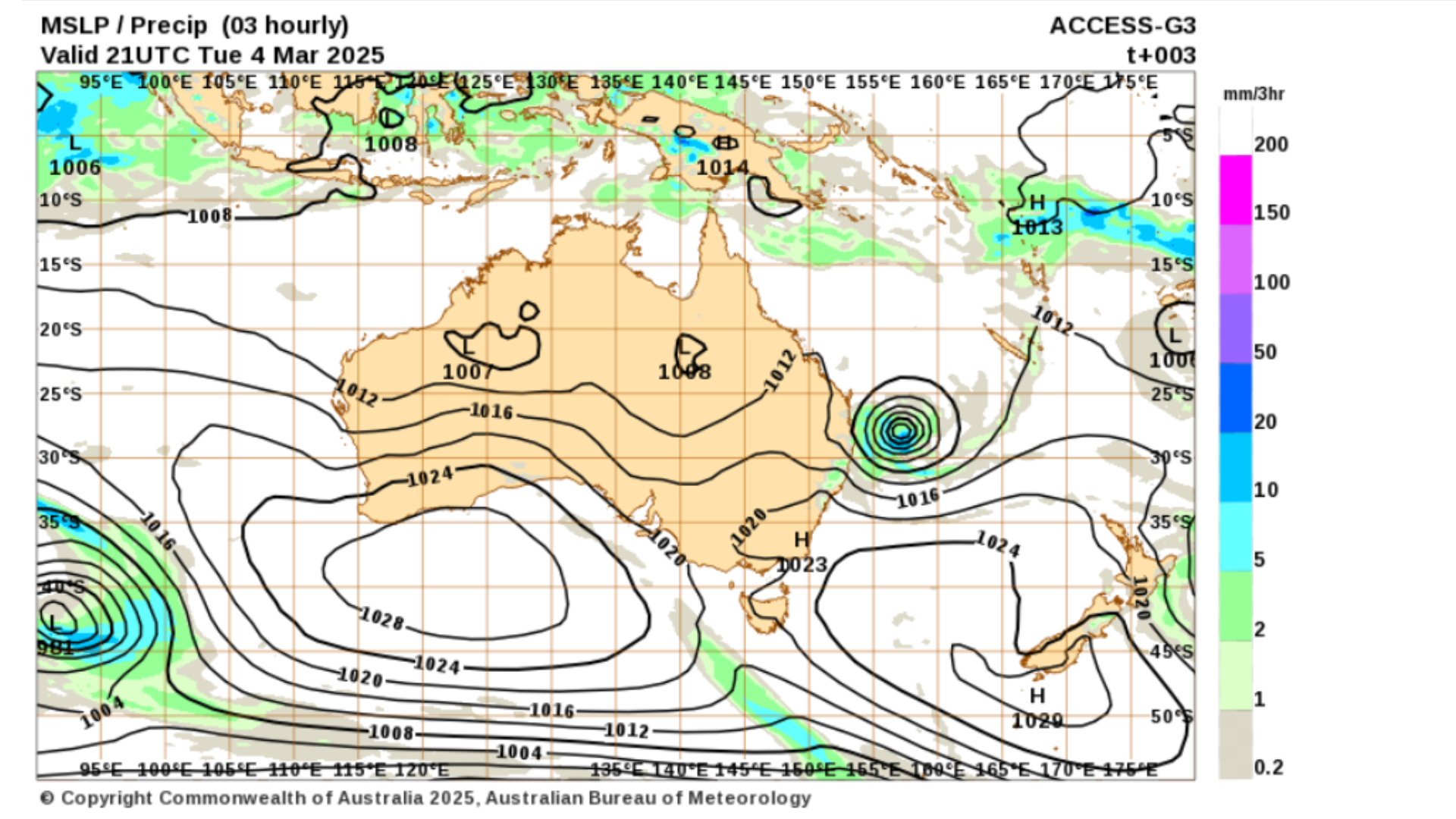
The latest rainfall map from the bureau shows a widespread area of extreme rainfall, particularly south of the cyclone’s landfall, with northern NSW and southeast Queensland at highest risk.
The purple and pink areas on the map indicate the most intense rainfall zones, where flash flooding and major river flooding are highly likely.
The Bureau of Meteorology has also issued its first flood warnings for NSW’s Northern Rivers, with major flooding possible along the Bellinger River at Thora and Bellingen from Friday (See post below).
Stuti Mishra5 March 2025 07:54
First flood warning issued for NSW as Cyclone Alfred nears
The Bureau of Meteorology (BoM) has issued its first flood warnings for NSW’s Northern Rivers, as Cyclone Alfred brings heavy rainfall to the region.
Major flooding is possible along the Bellinger River at Thora from Friday afternoon, with water levels expected to rise to 5.8 metres, BoM said.
In Bellingen, the river could surge to 8.2 metres on Saturday, prompting further warnings of major flooding.
Minor flood warnings have also been issued for Repton and the Kalang River at Urunga from Friday afternoon.
“The timing and location of the heaviest falls will depend on the track of the cyclone,” BoM said, adding that the situation is being closely monitored with more warnings to come.
Stuti Mishra5 March 2025 07:25
Cyclone Alfred already generating 8-metre waves near epicentre
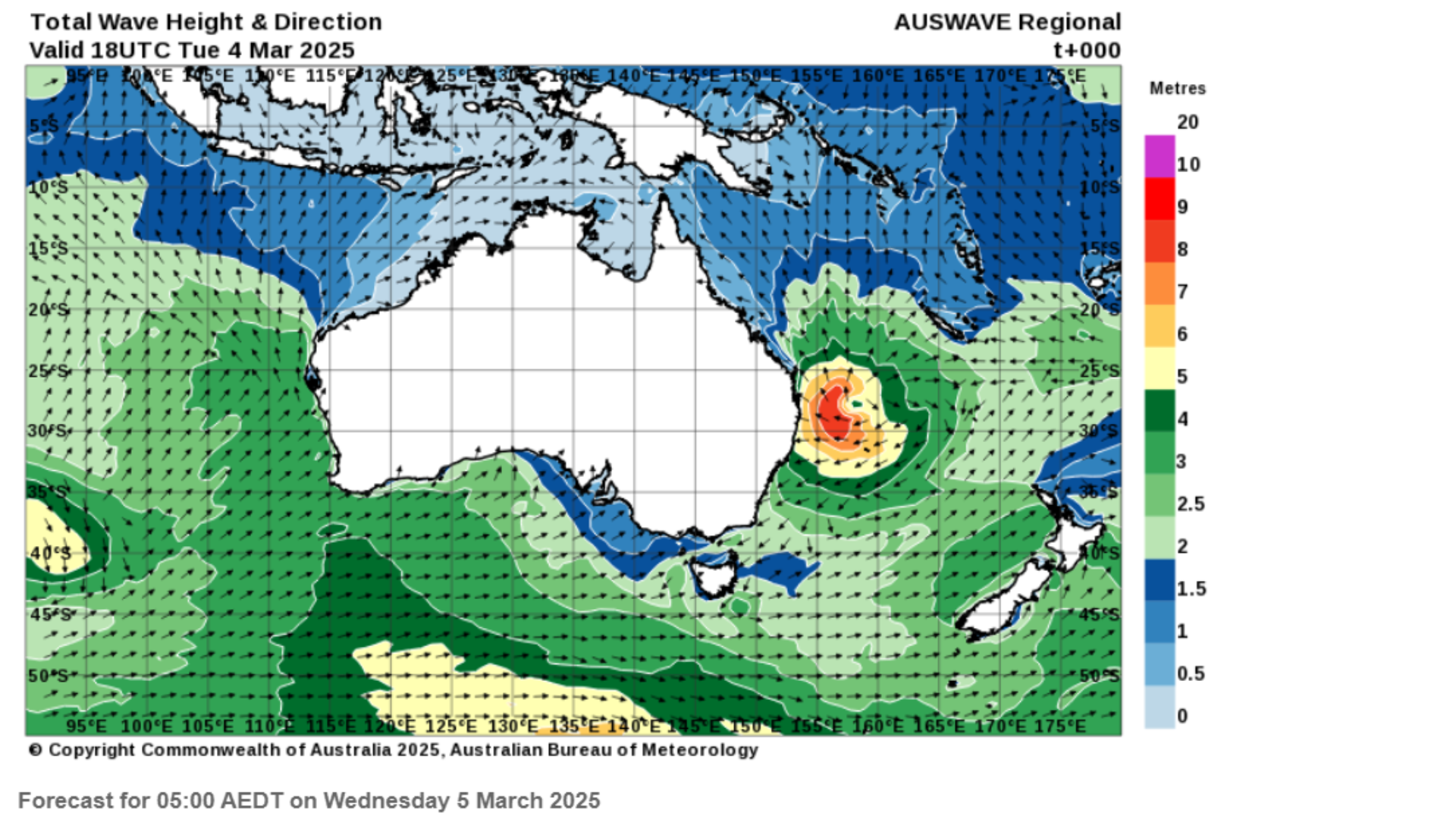
Massive waves are already building offshore as Cyclone Alfred moves closer, with wave heights exceeding 8–10 meters near the storm’s centre, forecast maps from Bureau of Meteorology (BoM), show.
As the cyclone moves closer, coastal areas in southeast Queensland and northern NSW could see dangerous storm surges, beach erosion, and life-threatening surf conditions over the next 48 hours.
Authorities are warning people to stay away from the water, as conditions will rapidly deteriorate. Flooded roads, coastal inundation, and strong rip currents are expected as the system nears landfall late Thursday or early Friday.
“Tropical Cyclone Alfred triggered the largest waves that we have recorded – over seven metres on Monday morning – since we first started measuring waves at One Tree Island in November 2022,” Professor Ana Vila-Concejo from the University of Sydney, said.
“What makes it uniquely hazardous,” she said, is that “the coast is already eroded from the run of NE and E swells and very high tides from the last couple of days.”
Stuti Mishra5 March 2025 06:48
Buses and trains in Brisbane to shut down tonight ahead of Cyclone Alfred
Brisbane City Council has announced all bus services will be suspended from tonight’s last service until further notice as Tropical Cyclone Alfred approaches.
Buses: Last services tonight, then fully suspended
Trains: Suspended from Thursday until further notice
CityCat & Ferries: Already suspended
Authorities say services will only resume when it is safe.
Stuti Mishra5 March 2025 06:30


